A one-van mechanic's whole front office, running while he's under a car.
A site that shows prices before you call, a booking engine that takes a deposit before the van rolls, and a phone that gets answered at two in the morning. Built for a certified mechanic who works out of his van and can't stop to pick up.
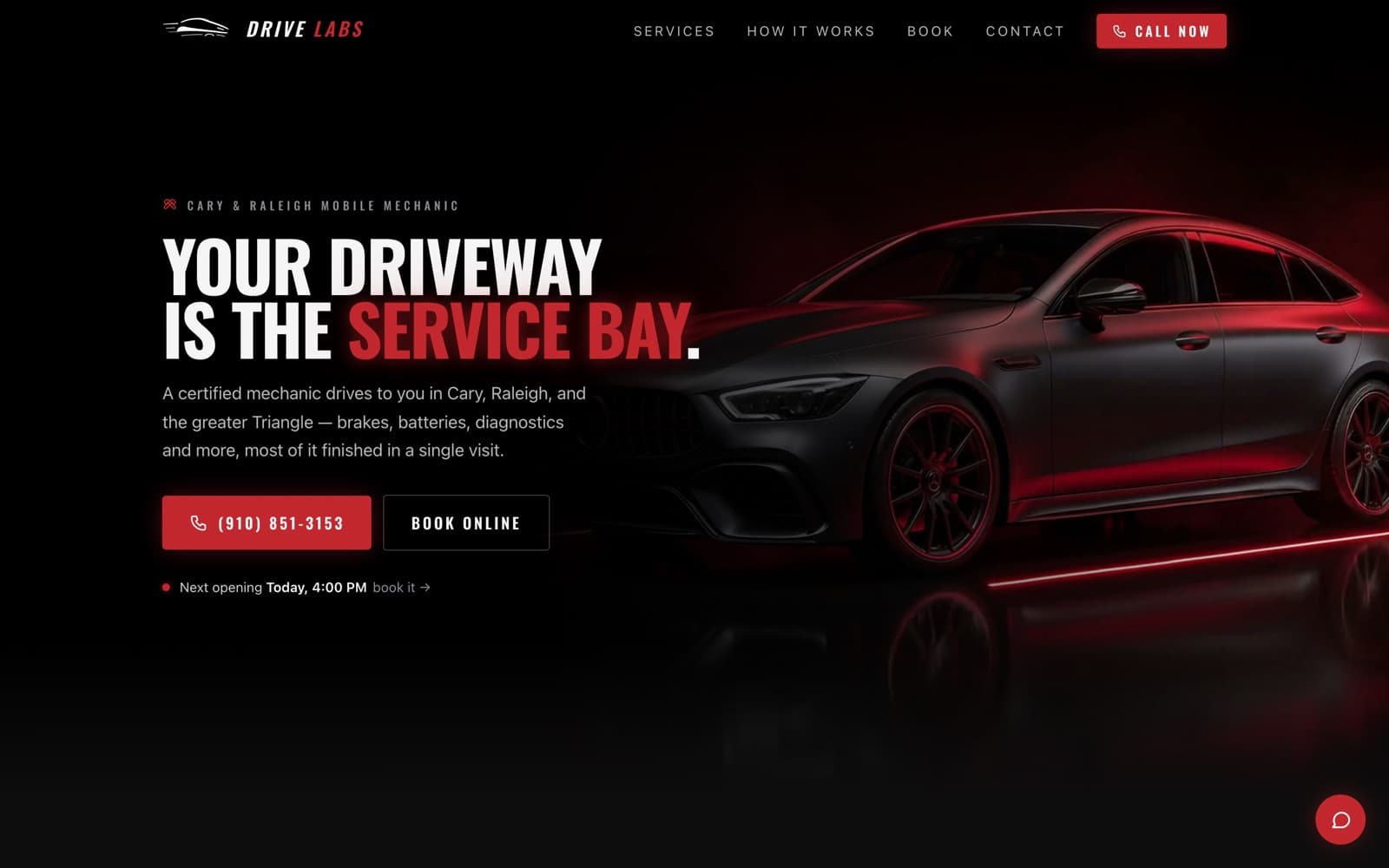
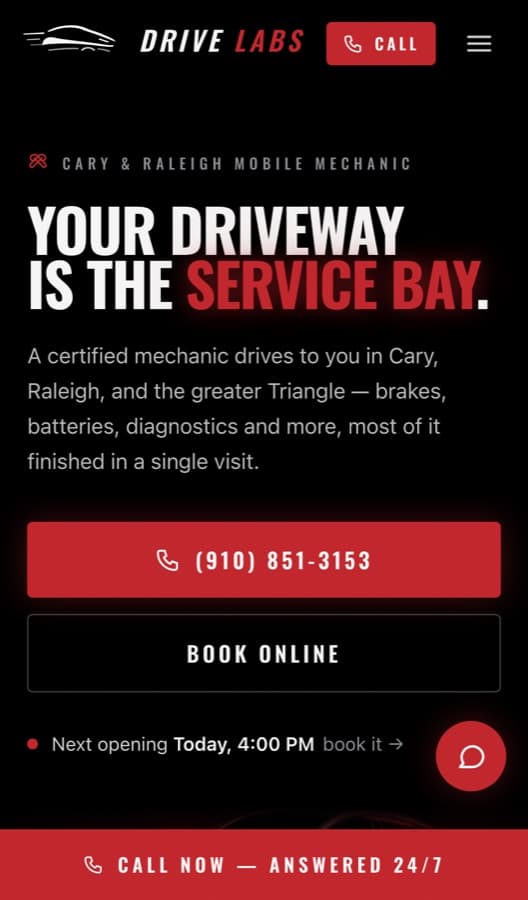
The part of the site people remember.
A 3D render of the car, driven by your scroll. Five services light up in turn, each named on the beat. On a desktop, scroll and it moves with you. On a phone, it costs you nothing until you tap play.

Cary & Raleigh mobile mechanic
Drive Labs
Your driveway is the service bay.
What comes in, what handles it, what goes out.
- Phone call, any hour
- Website visit
- Site chat
- Job on his Google Calendar
- $50 deposit in his Stripe
- Emergency routed to Chris
- Job list on his phone
Chris is a certified mechanic who drives to the customer: driveways, office parking lots, the roadside. There is no shop and no counter, which means there is also no one at the counter. Every job he books, he books himself, between jobs, on a phone with greasy hands.
Before this, the business ran on texts and a calendar in his head. A customer would ask if Tuesday worked, he'd answer when he surfaced, and by then a few of them had called someone else. Deposits were collected by hand, if at all, so a no-show cost him the drive and the slot.
He also had the problem most one-person trades have: the phone rings while the work is happening, and a missed call from a stranded driver is a job that goes to whoever answers next.
The problems, in the order they cost money.
The phone
Calls came in while he was under a car. Emergencies, the highest-value jobs, are also the least patient callers.
The booking
Every booking was a text thread. Availability lived in his head, so the customer had to wait for him to check.
The no-show
No deposit meant no commitment. A cancelled driveway visit cost the drive out and the slot he could have sold.
The price question
Half the inbound calls were people asking what an oil change or a brake job costs before deciding whether to book.
One system, in the tools the business already runs.
A scroll-driven cinematic hero
A 3D render of the car, driven by the visitor's scroll: oil, brakes, battery, diagnostics and tires light up in turn, each with its service named on the beat. It's the thing people react to in the room. It's on this page, live, above.
A site with the prices on it
Services and prices are visible before anyone calls: oil change, brakes, diagnostics, batteries, labor rate, after-hours rate. The phone number and the book button are reachable on a phone without scrolling, and the hero shows the next real opening, live from the calendar.
A booking engine, no vendor
Customers pick the services they need, and the site offers real open slots sized to the job plus travel time. A slot is held for twenty minutes while they pay, confirmed the moment the deposit lands, and released if it doesn't. Confirmed jobs feed straight into his Google Calendar.
A deposit before the van rolls
A $50 deposit through Stripe locks the slot. Until his Stripe account was connected, bookings still confirmed and the deposit was collected by hand, so the system never blocked a job.
Owner-run payments setup
He connects his own Stripe keys on a setup page inside his admin: three illustrated steps, keys checked against Stripe before saving, stored encrypted. No developer, no redeploy, no monthly software.
An AI front desk that knows it's a mobile shop
Phones are answered around the clock. The agent asks the two questions that matter for a mobile mechanic, whether the car currently starts and where it's sitting, books the routine work, and routes emergencies straight to Chris.
A job list on his phone
An admin page he bookmarks: today's jobs, what's paid, what's held. Sign in once per device, nothing sensitive in a URL.
The same moments, before and after the system.
The cinematic hero was right. The first phone version of it wasn't.
The scroll-driven sequence above is the thing people react to, and it's the reason a mobile mechanic's site looks like a brand. The first version shipped it the same way on every device: a phone downloaded 4.2 megabytes before it responded to a touch, and the scroll was hijacked to step chapter by chapter, so a stranded driver needed six deliberate swipes to reach the phone number.
The fix wasn't to remove the idea. It was to ship it correctly: on a desktop the video only downloads when the section is near and the visitor's own scroll drives it, with nothing intercepted. On a phone nothing heavy downloads at all; there's a 70-kilobyte ambient loop, and the full sequence plays only when someone taps it. Anyone who has asked their device for reduced motion gets a still. That's the version on this page, and it's the rule for every effect we ship: the baseline first, the phone number always reachable, the cinema layered on top.
Agreed, not yet shipped. Listed here so the page never claims more than what's live.
Estimates from the booking
Turn a booked job into a written estimate the customer approves before the visit.
The review request
A text after the job closes, timed to when people are happiest, linking to his Google reviews.
The monthly check-in
A short email to past customers on a service interval, so the second oil change comes back to him.
Three steps. The first one is free, and you can stop after any of them.
- 01Free · report within a week
The call, and your report
Nothing owed, nothing signed.
- A call about your business
- A written report, yours to keep
- No obligation to go further
- 02From $1,000 · typically 4–6 weeks
Go deeper, and build it
Only if the report showed you something worth having.
- A proper look at the opportunity you picked
- A working system, live, with your data and your rules
- 03Included with your build
It reports on itself
Included with whatever we build you.
- Reporting that shows what it returned
- Us on hand when things change
Want this for your business?
One call, then a written report: where your business leaks money, what each leak is worth, and what it would take to close it. Yours to keep either way.