A smart website and an AI secretary that answers in seconds, books every specialty, and never misses the reminder.
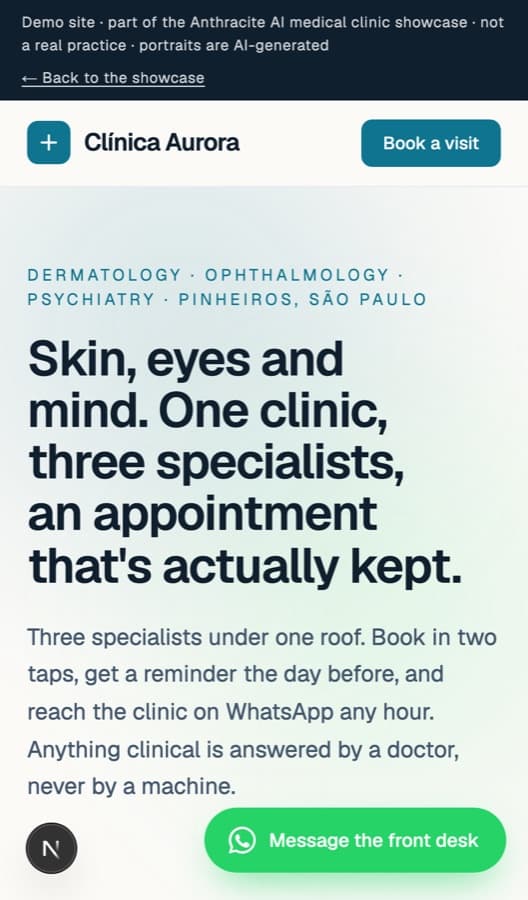
A complete demo build for a three-specialty clinic: dermatology, ophthalmology and psychiatry under one roof, a front desk that turns over, and patients who book on WhatsApp, by phone and by email. The site, the live receptionist and the numbers are all on this page. The doctors stay in control; the desk stops being the bottleneck.
A smart website, plus an AI secretary that handles the patients.
The secretary answers on WhatsApp, phone and email, books the appointments, sends the reminders, follows up after the visit and collects feedback. Anything clinical goes to the doctor. The site below is the demo build; the receptionist under it is live: text it.

Text the receptionist the way a patient would.
This is a live AI, not a script. Ask about prices, insurance, the doctors' days; try to book; ask it something clinical and watch it hand off to the doctor. Ten messages per session, no real bookings.
Three channels, one receptionist: the same conversations, as they'd happen.
Pick a channel and watch a real conversation play out: triage, booking, confirmation, reminder, follow-up. Anything clinical goes to a person. Everything else is handled, logged, and on the doctor's morning digest.
- Answered in 4 seconds, at 7:42 pm, with no one at the desk
- The right doctor, the right visit length, real openings
- Booked, confirmed, two reminders scheduled
- The clinical question went to the doctor, not the bot
- Everything on Dr. Lucas's morning digest
What it's worth to the practice.
What comes in, what handles it, what goes out.
- Phone call
- WhatsApp message
- Recall due date
- Visit on the right doctor's calendar
- Reminder 48h and 2h before
- Clinical question → a person
- Doctor's morning digest
Picture a clinic with three specialists: a dermatologist who owns it, an ophthalmologist and a psychiatrist who share the building and the front desk. Three calendars, three service lists, one reception. About 200 visits a week between them.
The front desk is the problem the owner names first. Receptionists are hired, trained, and gone within the year. In between, they miss appointments, don't know what each specialist actually offers, and put a doctor on the phone for questions the desk should answer. Patients book by phone and, mostly, by WhatsApp, which means bookings live in a chat thread nobody audits.
The owner isn't asking for less control. He's asking for a desk that knows the practice as well as he does and doesn't quit.
The problems we'd expect to find, in the order they cost money.
The no-show
No reminder, no easy way to reschedule, so a slot goes empty and the doctor's hour is spent. In outpatient care roughly one in four scheduled appointments is missed.
The unanswered line
Calls during clinic hours ring at a desk that's checking someone in. After hours, they ring at nothing. Each one is a patient who books elsewhere or doesn't book at all.
The doctor on the phone
“Does the dermatologist do that?” ends up with a doctor between patients. Three service catalogues that live in three doctors' heads can't be taught to a new hire in a week.
The recall that never happens
Annual exams, follow-ups, and chronic-care check-ins depend on someone remembering to call. Nobody does, so the practice's best patients drift.
One system, built around how the business already runs.
A front desk on phone, WhatsApp and email
One assistant answers all three channels in the clinic's voice, in Portuguese and English. It knows the full service catalogue for all three specialists because each doctor approved it, line by line, before it took a message. Anything clinical is handed to a human with the conversation attached; the assistant never gives medical advice.
Scheduling with each doctor's rules
Books into the clinic calendar with per-doctor rules: visit lengths by service, which days each specialist is in, telehealth follow-ups for psychiatry, buffer for procedures, and a cap on new-patient slots. The patient gets a confirmation on the channel they used.
Reminders with one-tap reschedule
Confirmation at booking, a reminder two days out and again the morning of, each with a reschedule option. A cancelled slot is offered to the waitlist automatically.
Recall campaigns
Annual exam due, follow-up overdue, prescription review coming up: the assistant reaches out on WhatsApp, books the visit, and logs it. The doctor sets the intervals once.
The doctor's daily digest
Every morning, to each doctor: what was booked, what was rescheduled, what was escalated, and any question the assistant couldn't answer, so the catalogue gets better every week. The owner sees everything and changes anything.
Data handling by design
Minimum data, held in the practice's own systems. Built for LGPD in Brazil and HIPAA in the US, with an audit trail of every message the assistant sent and every handoff to a person.
The same moments, before and after the system.
What it's worth, and how we got there.
The example practice books 200 visits a week across the three physicians at an average of $120 a visit, and we use 4.33 weeks to a month throughout.
No-shows: at the global average rate of 23%, 46 scheduled visits a week don't happen. At $120 that's $5,520 a week, about $23,900 a month of scheduled revenue that doesn't arrive.
Unanswered calls: say the desk takes 300 calls a week and one in five rings out during check-in or after hours. That's 60 calls; if one in four of those was a booking, that's 15 visits, $1,800 a week, about $7,800 a month.
The doctor on the phone: five interruptions a day at six minutes each is two and a half hours a week of physician time. At $150 an hour that's $375 a week, about $1,600 a month.
Recall: 250 patients a year are due an annual visit that nobody calls about. If 40% would book when asked, that's 100 visits a year, $12,000, about $1,000 a month.
Together, about $34,300 a month is leaking. We don't claim all of it. Reminders move attendance by roughly 14% relative in the evidence, so with the waitlist backfill and a same-day rebook we take a third of the no-shows ($8,000), half the unanswered bookings ($3,900), all of the recall ($1,000) and the doctor's phone time ($1,600): about $14,500 a month recoverable, or roughly $174,000 a year, for the example practice. Yours is built from your own logs in the first two weeks.
- The 23% is a global average across specialties and countries; a well-run private practice may already sit well under it, and the recovered number shrinks with it.
- Average visit value varies enormously between a family consult and a specialist procedure. We'd use the practice's own billing split, not one blended figure.
- Reminder effects in the literature are for text messages. Our assumption that WhatsApp performs at least as well is reasonable in Brazil, where it's the default channel, but it is an assumption.
- Call volume and the share that would have booked are assumptions. Two weeks of the practice's call log replaces both.
The second layer, once the front desk has a month of data behind it.
Intake before the visit
Insurance, history and consent collected on WhatsApp the day before, so check-in takes a minute.
Post-visit follow-up and reviews
A message after the visit with the care instructions the doctor chose, and a review link when the visit went well.
The practice's own numbers
Visits by service, by doctor, by source; no-show rate by day; what the desk handled without a person. One monthly page.
Three steps. The first one is free, and you can stop after any of them.
- 01Free · report within a week
The call, and your report
Nothing owed, nothing signed.
- A call about your business
- A written report, yours to keep
- No obligation to go further
- 02From $1,000 · typically 4–6 weeks
Go deeper, and build it
Only if the report showed you something worth having.
- A proper look at the opportunity you picked
- A working system, live, with your data and your rules
- 03Included with your build
It reports on itself
Included with whatever we build you.
- Reporting that shows what it returned
- Us on hand when things change
Want this with your own numbers in it?
One call, then a written report: where your business leaks money, what each leak is worth, and what it would take to close it. Yours to keep either way.
A showcase: a complete demo build for the industry, not a client. The practice is a demo and every figure is illustrative, with the arithmetic shown; yours is built from your own numbers.